The 20% Hit: How Cell Towers Devalue Residential Real Estate
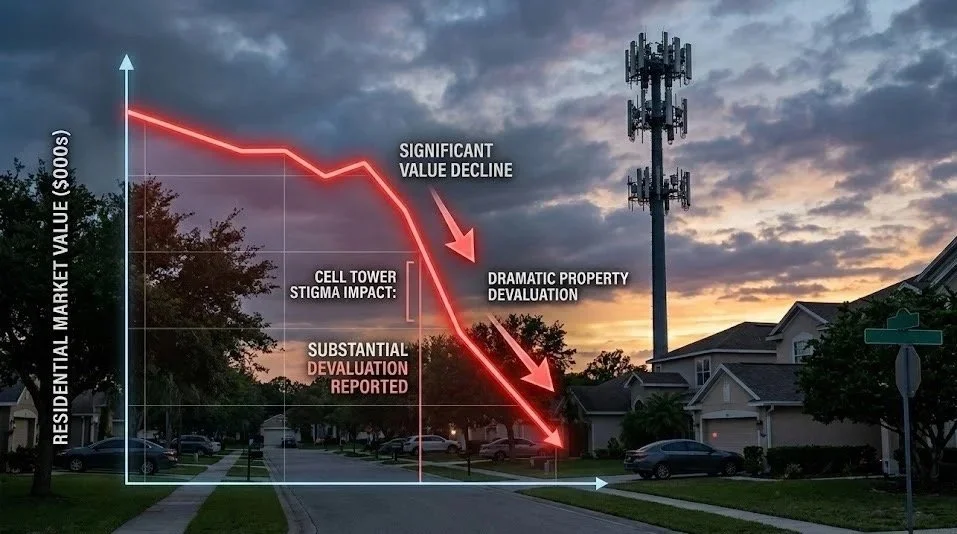
The Visual Reality of Equity Loss: This graphic illustrates the "stigma impact" real estate experts warn about. As a tower becomes a permanent fixture of the skyline, the pool of interested buyers evaporates, leading to the "20% Hit" that can strip a family of nearly $100,000 in home equity overnight.
For most American families, a home is more than just a shelter; it is their primary financial asset and the cornerstone of their generational wealth. When you purchase a home in a rural or residential community, you are investing in a specific quality of life—one defined by aesthetics, tranquility, and safety. However, a growing trend in the telecommunications industry is threatening this investment: the rapid placement of industrial-scale cell towers in the heart of residential neighborhoods.
While telecom giants often frame these installations as essential infrastructure for "connectivity," the real estate market tells a different story. Peer-reviewed research, realtor surveys, and expert appraisals consistently demonstrate that cell towers act as a significant "stigma" on residential property, often resulting in a devaluation of 20% or more. This article explores the economic impact of cell tower proximity, grounded in data from the National Association of REALTORS® (NAR), spatial econometric analyses, and independent appraisal studies.
1. The Realtor’s Perspective: Why 94% of Homebuyers Stay Away
The most immediate measure of a property's value is consumer demand. If a massive industrial structure is visible from a backyard or bedroom window, the pool of potential buyers shrinks almost instantly.
A landmark survey conducted by the National Institute for Science, Law & Public Policy (NISLAPP) revealed the depth of this "cell tower stigma." The study found that an overwhelming 94% of homebuyers and renters said they are less interested and would pay less for a property located near a cell tower or antenna. Even more striking, 79% of respondents said they would never purchase or rent a property within a few blocks of such infrastructure.
This sentiment is echoed in REALTOR® Magazine, which warns that cell towers and antennas are "problematic for buyers." In real estate markets across the country—from Michigan to New York—realtors have documented that homes adjacent to towers take significantly longer to sell and often require massive price cuts to close a deal. As one appraiser noted, "As realtors working in this market, we consistently see that towers negatively impact demand, creating a stigma that directly translates into lower property values."
2. The 20% Rule: Real-World Appraisal Data
While consumer sentiment is one metric, the professional appraisal of a home provides the "hard" economic data. David E. Burgoyne (ASA, SR/WA), a Certified General Real Estate Appraiser with decades of experience, has provided extensive expert testimony on this issue.
Burgoyne’s findings are clear: "In my professional experience, a visible cell tower in close proximity to a property can reduce its value by as much as 20%." This reduction is not just a theoretical projection; it is based on comparable sales data (comps) where houses near towers are compared to identical homes in the same neighborhood without a tower in sight.
For a homeowner in a community like Crystal River, FL, where home values might average $400,000, a 20% hit represents a **$80,000 loss in equity.** This is not a minor inconvenience; it is a devastating financial blow that can reset a family's financial future.
3. The Science of Spatial Econometrics: Proving the Decline
To move beyond anecdotal evidence, researchers use spatial econometric analysis—a complex statistical method that analyzes how location affects property prices. Unlike simple price averages, these models account for every variable of a home (square footage, age, lot size) to isolate the specific impact of the cell tower.
Key Global and Domestic Studies:
• Brisbane, Australia (Rajapaksa et al., 2018): Published in Environmental Economics and Policy Studies, this analysis of property transactions found that proximity to cell phone towers negatively affects house values, with the impact decreasing as the distance from the tower increases. The study suggested that compensation programs for nearby owners are an appropriate policy response to this "lost value."
• Mobile County, Alabama (Bond, 2007): A study published in The Appraisal Journal analyzed over 23,000 home sales. It found that homes within 0.72 km of a cell tower decreased in value by an average of 2.65%. However, if the tower was visible from the property, the decrease jumped to 9.78%.
• Central Kentucky (Locke & Blomquist, 2016): Using a rich dataset of residential sales, researchers found that a property with a visible antenna located 1,000 feet away sells for significantly less than a similar property located 4,500 feet away. The aggregate economic impact for properties within that 1,000-foot radius was estimated at $10 million.
• Johannesburg, South Africa (Cheruiyot et al., 2024): This recent 2024 study in the International Journal of Housing Markets and Analysis confirmed the trend: "The closer a residential property is to the tower, the greater the impact... on the selling price."
4. The HUD Classification: "Hazards and Nuisances"
The economic risk of cell towers is even recognized at the federal level by the U.S. Department of Housing and Urban Development (HUD). For decades, HUD has classified cell towers as "Hazards and Nuisances" in their valuation protocols.
Specifically, HUD guidelines (such as those in the FHA Single Family Housing Policy Handbook) often require that a property be located outside the "engineered fall zone" of a tower to be eligible for certain financing. If a tower is 195 feet tall, and its fall zone extends onto a neighboring property, that home may become unfinanceable for FHA-insured buyers. By shrinking the pool of eligible buyers (who often rely on FHA loans), the tower effectively forces the property value down further.
5. Why Does the Market React This Way?
The devaluation of property near cell towers is driven by three primary "market fears":
A. Aesthetic Blight
A 195-foot-tall multi-carrier monopole—like the one proposed for Hatfield Terrace in Crystal River—is an industrial structure. When placed in a rural or agricultural setting, it creates "aesthetic blight." It destroys the "peace and tranquility" and "rural character" that buyers are specifically looking for when they move away from urban centers.
B. Health and Biological Concerns
Regardless of whether a developer claims a tower meets 1996 FCC safety limits, the market's perception of health risk is an immutable fact. If a buyer has a choice between two identical houses—one with a tower and one without—they will choose the one without out of an abundance of caution for their children. This "precautionary avoidance" drives prices down.
C. Physical Safety and Liability
Towers introduce risks that typical residential neighborhoods don't have: fall zones, falling ice or debris, and potential fire hazards from electrical equipment. Furthermore, as major insurers like Swiss Re and Lloyd’s of London have begun to classify RF radiation as a "high-risk" liability (comparable to asbestos), homeowners fear they may one day be unable to insure their own properties or face liability themselves.
6. Fighting for Your Equity
The Telecommunications Act of 1996 often prevents local governments from denying towers based on health concerns alone. However, property devaluation is a legally valid ground for opposition.
When communities stand up against a "monstrosity" like the Blue Sky Tower, they aren't just fighting for our health— they are fighting to protect their life's work. The data is undeniable: cell towers in residential areas are an economic "silent poison" that strips families of their equity and neighborhoods of their character.
Protect your home. Protect your investment. Stop the tower.
Sources:
• National Association of REALTORS® (NAR):Cell Phone Towers and Home Values
• Environmental Health Sciences:Research Brief: Cell Towers Drop Property Values
• The Appraisal Journal:The Effect of Distance to Cell Phone Towers on House Prices (Bond, 2007)
• Environmental Economics and Policy Studies:Rajapaksa et al. (2018) Brisbane Study
• NISLAPP Survey:National Institute for Science, Law & Public Policy Survey on Cell Towers
• International Journal of Housing Markets and Analysis:Cheruiyot et al. (2024) Johannesburg Study